
Power-cycle your modem first, wait a full 60 seconds, then plug in your router and give it two minutes to reconnect. Run a wired speed and stability test on a laptop plugged directly into the router. If latency, jitter, and packet loss all come back clean, the reboot fixed it. If drops continue on the wired connection, the problem sits upstream in your modem, cabling, or ISP, not your Wi-Fi.
TL;DR:
- Running a wired speed and stability test immediately after power-cycling the modem confirms if the issue is upstream or internal to your home network.
- Testing multiple devices and times helps determine if the instability affects the entire network or just one device, guiding appropriate fixes.
- Moving the router, updating firmware, and manually selecting Wi-Fi channels can often resolve Wi-Fi drops without replacing hardware.
- Wired fixes like swapping cables, ports, or switching to Ethernet backhaul can eliminate line or hardware issues causing persistent drops.
- Using comprehensive stability tests that log latency, jitter, packet loss, and bufferbloat provides a clear picture of true connection health over simple speed tests.
Table of Contents
- Diagnosing an Unstable Internet Fix in Five Minutes
- Is It One Device or the Whole Network?
- Router and Wi-Fi Fixes That Actually Stop the Drops
- How Do I Fix Unstable Internet on Just One PC?
- When the Problem Is Your Modem, Cabling, or ISP
- Verify the Fix: Which Metrics Actually Matter?
- Emergency Fixes to Stay Online Right Now
- Habits That Prevent the Next Outage
- Run a Real Stability Test Before You Blame Your Router
- Sources
- FAQ
Diagnosing an Unstable Internet Fix in Five Minutes
Before touching settings, spend five minutes narrowing down where the failure actually lives. Most unstable internet fix attempts fail because people jump straight to buying a new router when the real problem is a stuck DHCP lease or an ISP outage down the street.
- Check for an outage first. Switch your phone to mobile data and try loading a site, or check your provider's status page. If your neighbors are down too, no amount of router fiddling will help.
- Power-cycle in the correct order. Unplug the modem, wait about half a minute, plug it back in, and wait until its lights stabilize. Only then plug the router back in. This sequence forces a fresh handshake with your ISP and clears a surprising number of temporary glitches.
- Run a wired test. Connect a laptop or desktop directly to the router's LAN port with an Ethernet cable and run a speed and stability check.
- Check the affected device. Reboot it, forget the Wi-Fi network and rejoin it, and toggle airplane mode on and off if it's a phone or tablet.
- Write down what you saw. Note whether the wired test was clean, whether one device or all of them struggled, and what time of day the drops happened.
That last step matters more than people think. If the wired test is rock solid but Wi-Fi keeps failing, you're dealing with a wireless problem. If both fail, the issue is your modem, your cabling, or your ISP, and no channel change or router reboot will touch it.
Is It One Device or the Whole Network?
This is the fork in the road that determines everything else you do. Test the same connection on at least two different devices, at two different times of day, before concluding anything.
- Run the same speed and stability test wired and over Wi-Fi on the same device, back to back. A wired connection is inherently more consistent than wireless, so any gap between the two points to a Wi-Fi problem rather than a network-wide one.
- Test a second and third device if you have them. A phone, a laptop, and a smart TV all dropping at the same moment means the network itself is unstable, not any single gadget.
- Note the clock. Drops that cluster around 7 to 10 PM often mean neighborhood congestion on your ISP's node, not anything you can fix at home.
- Run a continuous ping for two or three minutes (ping google.com -t on Windows, or a stability monitor) while streaming or gaming. Sporadic spikes or timeouts during that window confirm intermittent packet loss rather than a one-time fluke.
If only one device struggles while everything else is fine, skip ahead to device-specific fixes. If every device on the network suffers at the same time, especially over both Wi-Fi and Ethernet, escalate straight to the modem and ISP checks.
Router and Wi-Fi Fixes That Actually Stop the Drops
Most Wi-Fi instability traces back to three things: where the router sits, which channel it's broadcasting on, and how old its firmware is. Fixing those three costs nothing and often outperforms buying a new router entirely.
- Move the router. Place it centrally, off the floor, and away from thick walls, metal cabinets, and large appliances, all of which absorb or reflect the signal.
- Pick a clean channel manually. On 2.4 GHz, stick to channels 1, 6, or 11 to avoid overlap. Use a free Wi-Fi analyzer app to see which channel your neighbors are already crowding.
- Split or steer your bands deliberately. Put bandwidth-hungry stationary devices on 5 GHz or 6 GHz for speed, and put smart-home gadgets on 2.4 GHz for range. If your router does automatic band steering and it's misbehaving, try splitting the SSIDs manually instead.
- Update firmware, but don't reboot reflexively. Some router makers actually advise against routine reboots unless there's active interference. A reboot mainly helps 2.4 GHz routers rescan for a quieter channel; it's not a universal cure, and firmware updates matter more for long-term stability.
- Turn on QoS for the device that needs it most. Most router apps or web admin panels let you prioritize latency-sensitive traffic like video calls or gaming, so one device hogging bandwidth doesn't tank someone else's meeting. This is especially useful if you're troubleshooting drops during video calls.
- Wire your mesh nodes if you can. Mesh systems connected by Ethernet backhaul instead of relying purely on wireless hops are dramatically more stable, particularly in larger homes with multiple nodes.
- Hunt down interference sources. Microwaves, cordless phone base stations, baby monitors, and even some Bluetooth speakers can clash with 2.4 GHz Wi-Fi. If drops happen at the same time every day, check what's running nearby.
If you've moved the router, split your bands, and updated firmware and still see periodic dead zones, a Wi-Fi extender, a proper mesh kit, or a powerline adapter run through your home's electrical wiring can fill the gap without rewiring the house.
Pro Tip: Test one change at a time and re-run a stability check after each one. Changing the channel, the band, and the router's position all in the same afternoon means you'll never know which fix actually worked.
How Do I Fix Unstable Internet on Just One PC?
When every other device is fine but one computer keeps dropping, the fault almost always lives in that machine's network stack, not the router.
- Update or reinstall the network adapter driver. An outdated or corrupted Wi-Fi driver is one of the most common single-device culprits, and a fresh driver from the manufacturer's site often resolves it outright.
- Flush DNS and test a different resolver. Run
ipconfig /flushdnson Windows, then try a public DNS resolver temporarily to see if resolution delays were the real cause. Switch back to automatic if it doesn't help. - Release and renew the IP address. Run
ipconfig /releasefollowed byipconfig /renew, or forget the Wi-Fi network entirely and rejoin it from scratch. This clears a stuck or conflicting lease. - Reset network settings if nothing else works. Windows and macOS both have a full network reset option that rebuilds adapters and protocols from default.
- Check what's eating bandwidth in the background. Cloud backup syncing, pending OS updates, and even some antivirus tools can quietly saturate a connection and make it look unstable. A VPN with a flaky server can cause the same symptom.
- Try different hardware. Plug into a different USB port, or swap in a USB-to-Ethernet adapter to rule out a failing internal Wi-Fi card entirely.
If a wired USB-to-Ethernet adapter fixes the problem instantly, you've found your answer: the internal wireless adapter is the failure point, not your network.
When the Problem Is Your Modem, Cabling, or ISP
If wired tests still drop, stop troubleshooting software and start checking hardware. This is where most people give up too early and blame their ISP without evidence.
- Inspect every coax, phone, and Ethernet cable for cracks, loose connectors, or corrosion, and swap in a spare if you have one.
- Try a different LAN port on the router. A single dead port can look exactly like a network-wide problem.
- Watch the modem's lights during a drop. A blinking or red "online" or "signal" light usually points to a line issue rather than anything inside your home.
- If wired connections drop with clean lights, a factory reset on the modem (not just a reboot) is worth trying before calling support.
- Screenshot your speed and stability test results with timestamps every time a drop happens. Handing your provider concrete evidence instead of "it keeps cutting out" gets you past the first-tier script and to someone who can actually check the line.
Repeated wired drops with a struggling modem light are the clearest signal that this is no longer a home-network problem. It's a line or ISP issue, and no cable swap on your end will fix it.
Verify the Fix: Which Metrics Actually Matter?
A single speed test tells you almost nothing about stability. Repeated short tests plus a longer continuous monitor catch the transient packet loss and jitter spikes that a ten-second snapshot misses entirely. Run at least three tests spread across different times, then let a monitor run for several minutes during normal use.
| Metric | What it measures | Rough guidance |
|---|---|---|
| Latency (median and spikes) | Round-trip delay to a server | Spikes far above your median point to instability, not just slowness |
| Jitter | Variation in latency between packets | High jitter causes stutter in calls and games even when average speed looks fine |
| Packet loss | Percentage of data that never arrives | Above roughly 1% starts causing real problems for VoIP and gaming |
| Bufferbloat | Latency increase under load | Severe bufferbloat means your connection chokes the moment it gets busy |
Running a detailed stability test that logs all four numbers together, alongside a saved history of past runs, is what actually proves an intermittent problem exists instead of you just feeling like your internet is slow.
Emergency Fixes to Stay Online Right Now
Sometimes you don't have time to diagnose anything, you just need the call or stream to survive the next 20 minutes.
- Tether to your phone's 4G or 5G hotspot immediately and move your laptop's internet source over.
- Pause any cloud backup or large download running in the background on every device sharing the connection.
- If your router supports QoS, bump priority for the device on the call right now, even temporarily.
- Grab a USB-to-Ethernet adapter and plug in directly if Wi-Fi is the one flaking, not the whole network.
Pro Tip: Keep a cheap USB-to-Ethernet adapter in your laptop bag. It's the fastest fix for a shaky wireless connection during something you can't afford to lose, and it costs less than a single missed client call.
Habits That Prevent the Next Outage
Most instability I see traced back doesn't announce itself with a dramatic outage. It shows up as a slow drift: firmware two versions behind, a cable nobody's checked in three years, jitter creeping up every few weeks. Building a habit of checking firmware monthly, keeping a spare cable on hand, and running a scheduled stability test catches that drift while it's still small. A saved test history and a data capacity calculator make patterns visible long before they wreck a livestream or an important call.
— Peter D
Run a Real Stability Test Before You Blame Your Router
Guesswork is the enemy of a fast unstable internet fix, and most speed tests only tell you half the story. Grandspeed measures latency, jitter, packet loss, bufferbloat, and DNS resolution time in one pass, then saves every result to a test history so you can actually see whether last week's fix held up or the problem crept back.
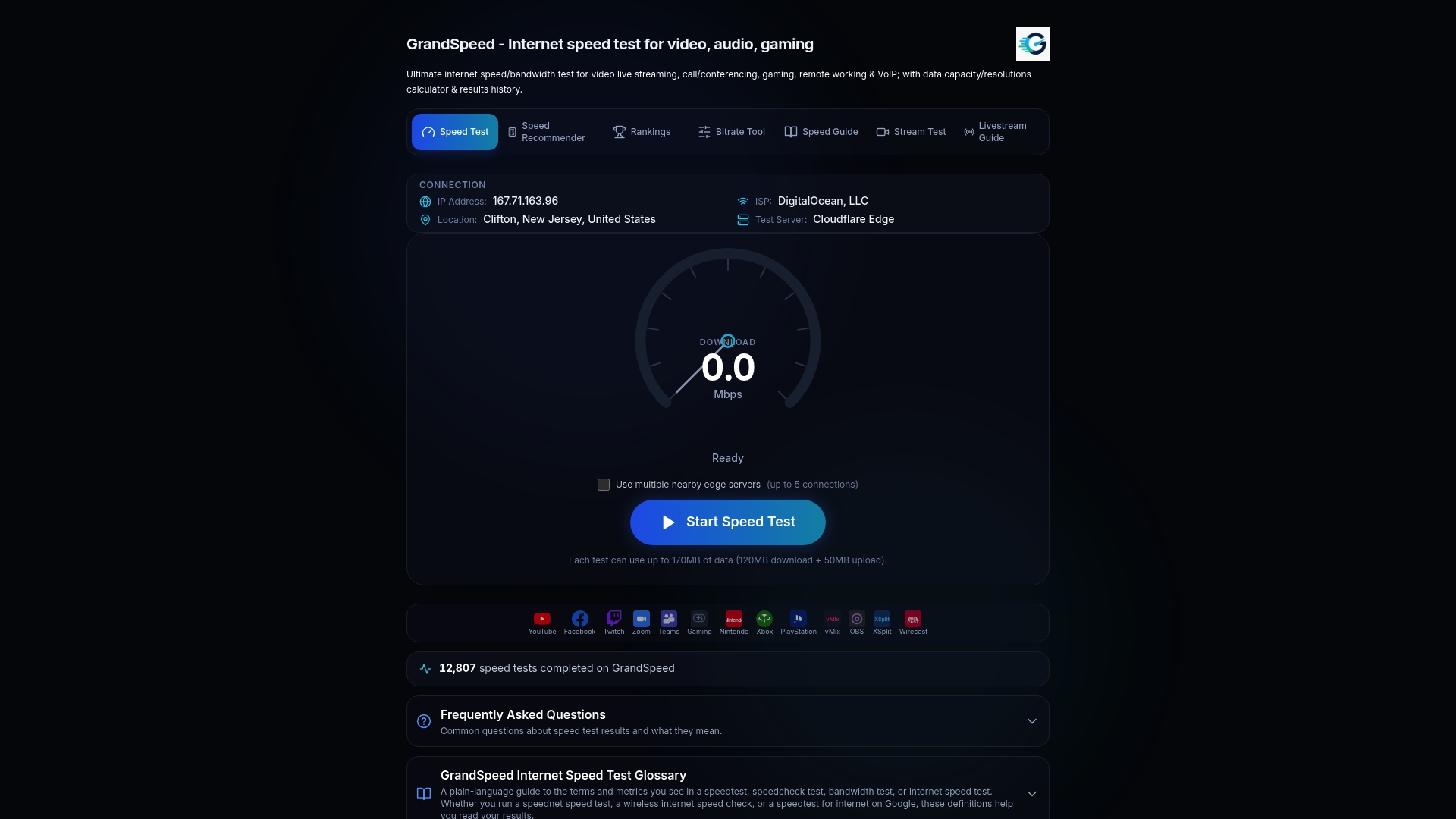
That history matters when you're the one trying to convince an ISP that your connection drops every evening at 8 PM, not just "sometimes." It also matters for anything bandwidth-sensitive: The tool can help estimate the maximum stream resolution your current connection can support, so you're not guessing whether a bad stream was your internet or your settings. Run a full Grandspeed the next time your connection feels off, save the results, and you'll have real numbers instead of a hunch the next time you need to prove it.
Sources
- What is Quality of Service (QoS)? — LiveAction
- 13 tips to troubleshoot your internet connection and get back online — PCMag
- 12 ways to upgrade your Wi‑Fi and make your internet faster — WIRED
- These Wi‑Fi tweaks cost nothing—and they beat a $300 router upgrade — HowToGeek
FAQ
How do I fix a fluctuating internet connection?
Power-cycle the modem and router in that order, then run a wired test to see if the fluctuation follows the device or the network. If it's network-wide, check channel congestion, firmware, and cabling before calling your ISP.
What makes my internet connection unstable?
The most common causes are Wi-Fi interference or poor router placement, outdated firmware, an overloaded network with too many devices, or an upstream problem in your modem, cabling, or your ISP's line.
How do I improve my Wi-Fi stability?
Move the router to a central, elevated spot away from walls and appliances, manually pick a clean 2.4 GHz channel like 1, 6, or 11, keep firmware current, and enable QoS to protect latency-sensitive traffic like calls and gaming.
How do I test if my internet is unstable?
Run a wired speed test alongside a multi-minute continuous latency check that reports jitter and packet loss, since a single quick speed test often misses intermittent drops entirely. A tool like Grandspeed's stability test logs all of these together with a saved history for comparison over time.